
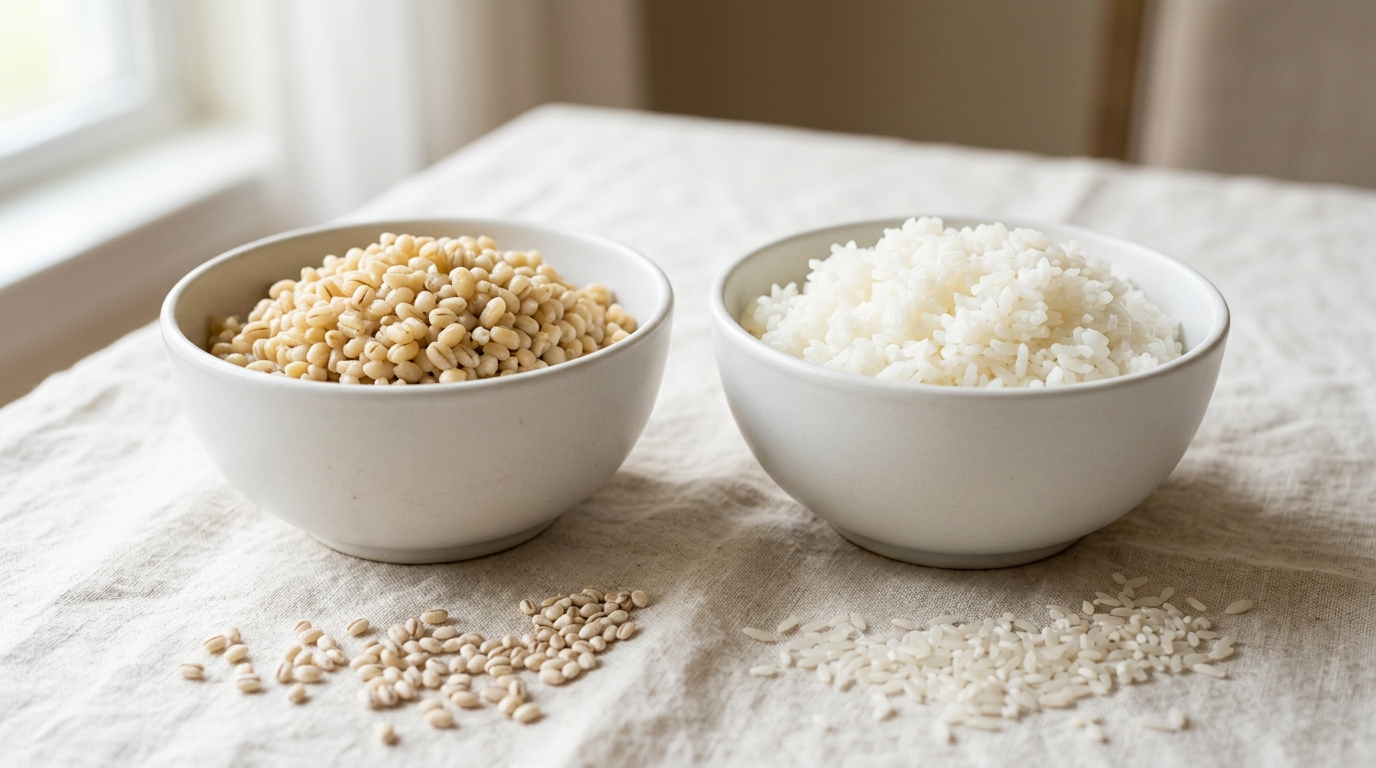
If rice is a staple at your table, pearl barley is the swap most people overlook. It has the lowest glycemic index of any common grain, 28 compared with 73 for long-grain white rice and 68 for brown, and it cooks up chewy and filling in about the same time as brown rice. Here’s how barley stacks up against rice and the other grains that beat it.
Pearl barley: GI 28, GL 9 per ¾ cup cooked
Long-grain white rice: GI 73, GL 26
Brown rice: GI 68, GL 22, only a little lower than white
Barley, rice, and other grains compared
| Grain | GI | GL | Serving |
|---|---|---|---|
| Pearl barley | 28 | 9 | 150 g cooked |
| Parboiled (converted) rice | 38 | 14 | 150 g cooked |
| Bulgur | 48 | 12 | 150 g cooked |
| Buckwheat (kasha) | 49 | 15 | 150 g cooked |
| Quinoa | 53 | 13 | 150 g cooked |
| Wild rice | 57 | 18 | 150 g cooked |
| Basmati rice | 58 | 22 | 150 g cooked |
| Couscous | 65 | 23 | 150 g cooked |
| Brown rice | 68 | 22 | 150 g cooked |
| White rice, long-grain | 73 | 26 | 150 g cooked |
| Jasmine rice | 89 | 37 | 150 g cooked |
150 g cooked is about ¾ cup. GI: low 55 or less, medium 56–69, high 70+. GL per serving: low 10 or less, medium 11–19, high 20+. More on the rice and grains page.
Why barley is so low
Soluble fiber. Barley is rich in beta-glucan, a soluble fiber that thickens into a gel in the gut and slows how quickly starch is absorbed. It’s the same type of fiber found in oats, and it’s the basis of an FDA-authorized health claim linking barley beta-glucan to lower risk of heart disease through its effect on cholesterol.
Dense, intact grains. Even polished pearl barley keeps a firm kernel that holds its shape when cooked. Starch locked inside a whole kernel digests more slowly than starch in soft, sticky rice.
It may help the next meal, too. Studies from Sweden found that eating barley-based foods in the evening improved the blood sugar response to the next morning’s breakfast, likely because of how its fiber is fermented in the gut overnight.
Why brown rice isn’t the answer it seems
Brown rice has more fiber and nutrients than white, but its GI (68) is only a little lower than long-grain white (73). The rice that beats it is parboiled, or “converted,” rice (38), which is steamed in the husk before milling so its starch firms up. If you want to stay with rice, parboiled or basmati are better everyday choices than brown.
How to cook and use barley
- Pearl barley: simmer 1 cup in about 3 cups of water or broth for 25–40 minutes, until tender but chewy, then drain any extra liquid. This is the version in most supermarkets.
- Hulled barley: the whole-grain version, with more fiber. It takes closer to an hour; soaking it overnight shortens that.
- Use it anywhere you’d use rice: grain bowls, stir-fries, stuffed peppers, and pilafs. It holds up better than rice in soups and makes a creamy “barley risotto.”
- Batch it. Cooked barley keeps about five days in the fridge and freezes well in portions.
- Not gluten-free. Barley contains gluten. For a gluten-free low-GI option, use buckwheat (49) or quinoa (53).
Frequently asked questions
Is barley better than rice for blood sugar?
By GI and glycemic load, yes. Pearl barley tests at 28 with a GL of 9 per ¾ cup, compared with 73 and 26 for long-grain white rice and 68 and 22 for brown.
What’s the lowest glycemic rice?
Parboiled, or converted, rice at 38. Basmati (58) and wild rice (57) are next. Jasmine (89) and sticky rice (92) are the highest.
Does pearl barley still count as a whole grain?
Not technically, since some of the bran is polished off. It still has a very low GI and a good amount of fiber. Hulled barley is the whole-grain version.
GI values vary between tests. This page is general information, not medical advice. Last reviewed October 2026.